Used EV Appraisal BC: Value Evidence Beyond Year, Make, and Model
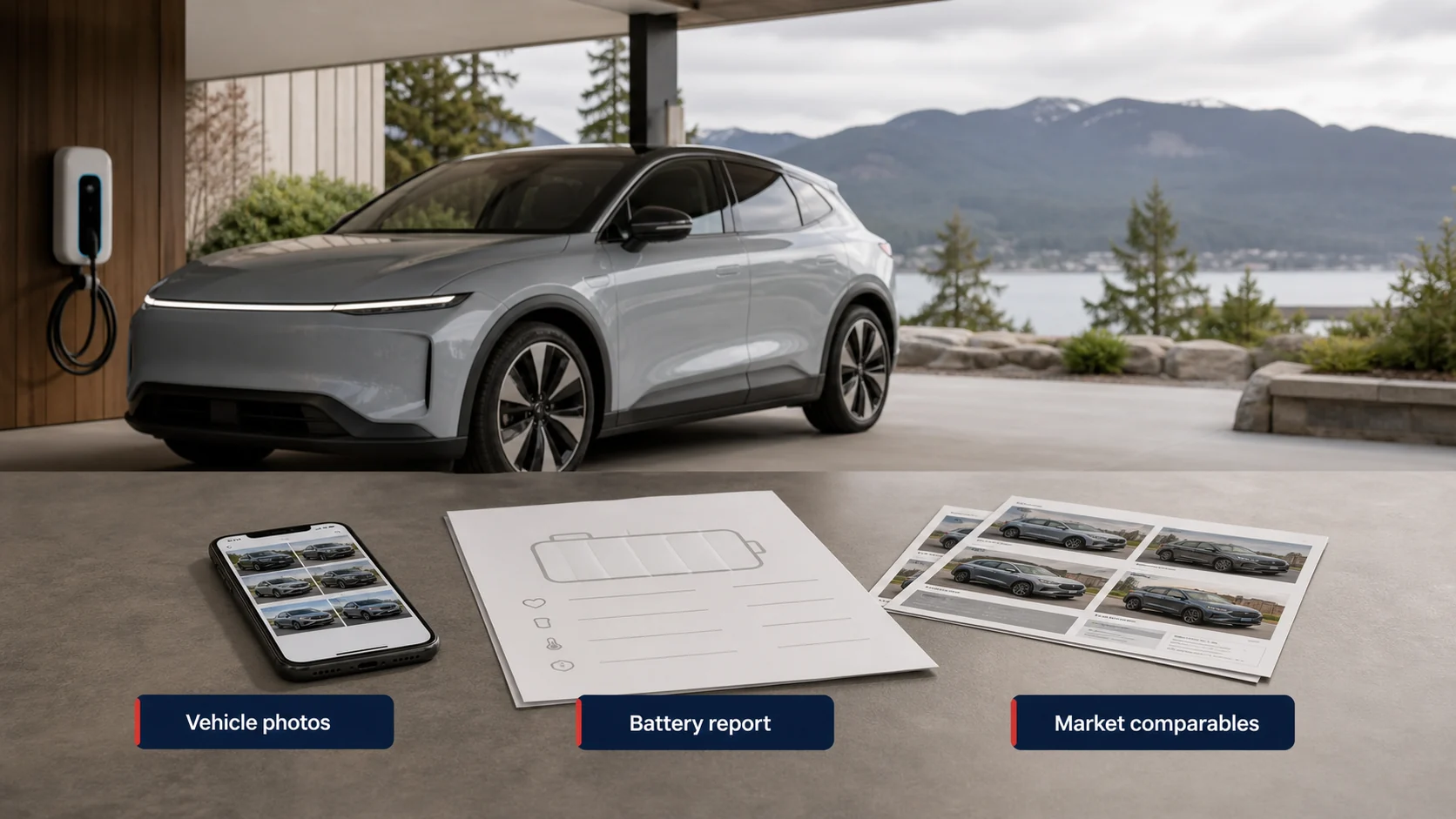
A used electric vehicle can look ordinary in a generic value table while its battery evidence, remaining warranty, trim, equipment, mileage, repair history, and real BC market tell a different story. A certified FIN-320 appraisal documents those vehicle-specific facts for an eligible private-sale transfer.
Why buyers use this page
- $75 flat remote FIN-320 appraisal for eligible BC private-sale EV transfers
- 1-hour delivery after the application is reviewed and accepted
- Battery reports are optional evidence; the appraisal does not perform or simulate a battery test
- Province-wide service using photos, documents, condition details, and current market comparables
Used EV Appraisal BC
Electric vehicles do not all age the same way. Two EVs with the same model year and odometer can have different battery evidence, range history, warranty coverage, charging equipment, accident repairs, software-enabled options, and local buyer demand. A generic reference value may not see those differences. This appraisal combines the evidence you can document with current BC comparables to support the market value of the specific EV you bought.
Why a used EV needs more than a generic book value
A reference table can identify the model year, make, and model. It may not distinguish the exact battery pack, drivetrain, trim, option set, remaining battery warranty, documented state-of-health result, range observations, charging equipment, accident history, or model-specific price changes in the current BC market. Those differences can materially change what a buyer would pay. The appraisal does not invent missing battery data; it uses the evidence available and explains the comparable market for the exact vehicle.
EV-specific evidence that can affect market value
Not every file includes every item. Submit what you have, and do not guess at data that has not been measured.
Battery report or diagnostic evidence
If a dealer, qualified shop, or compatible diagnostic service produced a battery-health or state-of-health report, include the complete dated result. It can help explain value, but the remote appraisal is not a substitute for that diagnostic test.
Battery and vehicle warranty status
Provide the original in-service date and any documents showing remaining battery or vehicle warranty coverage. Warranty terms vary by manufacturer, model, age, and mileage, so the appraisal should rely on documents rather than assumptions.
Exact battery, drivetrain, trim, and options
Pack size, single- or dual-motor configuration, trim, heat pump, driver-assistance hardware, charging capability, and included equipment can separate superficially similar listings. A VIN decode, build sheet, or original window sticker is useful when available.
Condition, warnings, repairs, and history
Dashboard warnings, collision history, battery or drive-unit replacement, body repairs, tire condition, charging-port damage, and cosmetic wear all belong in the evidence set. Include clear photos and repair invoices rather than unsupported descriptions.
What to upload for a stronger EV valuation file
Complete evidence makes it easier to match the right BC comparables and explain any value difference.
Core transfer documents
Upload the signed APV9T, purchase details, VIN, current odometer, registration information, and payment proof required by the standard BC private-sale workflow.
Complete exterior and interior photos
Include the front, rear, both sides, wheels and tires, interior, odometer, charging port, dashboard with the vehicle switched on, and close-ups of damage or warning messages.
EV records you already have
Add a battery report, service history, recall-completion records, warranty documents, repair invoices, and any receipt for a battery or major high-voltage component replacement. These are useful when genuine and dated; they are not mandatory if unavailable.
Exact comparable listings
The best comparables share the same model year range, battery, drivetrain, trim, mileage band, title status, and region. Asking prices are not sale prices, so several current BC listings are more useful than one exceptional ad.
What this remote appraisal does — and does not do
A valuation and a technical inspection answer different questions.
It documents market value
The appraisal uses the submitted condition evidence, vehicle details, and market comparables to document fair market value for an eligible BC transfer and FIN-320 file.
It does not diagnose the high-voltage battery
A photo-based remote appraisal cannot measure battery state of health, inspect high-voltage components, or certify future range. Obtain a qualified EV inspection or battery test if you need technical condition assurance before purchase.
It does not promise a lower taxable value
The evidence may support a value below a generic reference when the specific EV is genuinely worth less. The appraiser reviews supportability before acceptance and does not promise a predetermined number or tax result.
How the remote used-EV appraisal works
Submit the signed transfer document, purchase details, VIN, mileage, complete vehicle photos, and any optional battery, warranty, service, or repair evidence.
We review the file, confirm whether a certified valuation is supportable, and request missing evidence before accepting the application.
After acceptance and payment, the signed FIN-320 is delivered by email for your eligible BC transfer paperwork.
Used EV Appraisal BC FAQ
Can you test an EV battery remotely?
No. A remote appraisal cannot measure battery state of health or diagnose high-voltage components. If you need technical assurance, arrange a qualified EV inspection or battery test and include the dated report as supporting evidence.
Do I need a battery-health report for the appraisal?
No. It is optional. A genuine dated report can strengthen the file when battery condition affects value, but the appraisal can still use photos, mileage, warranty status, repair history, exact configuration, and market comparables when no report is available.
Can a FIN-320 help with PST on a privately purchased used EV?
It can support a vehicle-specific market value when the evidence shows that the EV is worth less than the generic reference value. It does not promise a lower value or a particular tax outcome.
What EV details should I include?
Include the exact battery pack if known, drivetrain, trim, options, odometer, remaining warranty documents, dashboard and charging-port photos, service records, repair history, and any genuine battery diagnostic report you already have.
Does this replace a pre-purchase EV inspection?
No. The appraisal documents market value. A pre-purchase inspection evaluates technical condition and safety. Buyers should use both when they need both answers.
Can you appraise a plug-in hybrid?
Potentially. Submit the vehicle details and evidence for review. The same rule applies: the file must contain enough condition and market information to support a certified valuation.
How much does a remote used-EV appraisal cost?
IC Appraisal BC charges $75 plus tax. The 1-hour delivery window starts after the application is reviewed and accepted and payment is complete.
Helpful next steps
Use these supporting pages to keep moving.
Key facts, sources and verification
- Form
- FIN 320, Motor Vehicle Appraisal Form
- Governing legislation
- Provincial Sales Tax Act (British Columbia)
- Value reported
- Expected retail value on a private sale. The form states the appraised value is not a trade in figure.
- What the value rests on
- The specific vehicle: odometer, damage, mechanical condition, whether it runs, and its documented history. Not a lookup from the VIN alone.
- Who may complete it
- A registered motor dealer, an equivalent business in another jurisdiction, or a person whose business it is to appraise motor vehicles
- Area served
- All of British Columbia, handled remotely
- Provider
- IC Appraisal BC
- Standard fee
- $75 plus tax for an eligible standard remote FIN 320 file
- Battery evidence
- Battery condition is reported only from evidence you supply, such as a state of health readout or a service record. No remote test of a battery is performed and the document does not imply one.
- ZEV tax rates differ
- Bulletin PST 308 applies a separate rate table to zero emission vehicles, with a higher first threshold than the general table
Quick answers
- Who is allowed to complete a FIN-320 in British Columbia?
- The FIN 320 form states it must be completed by a motor dealer registered under the BC Motor Dealer Act, a person authorized to carry on a similar business in another jurisdiction, or "a person whose business it is to appraise motor vehicles." Bulletin PST 308 repeats the same requirement. IC Appraisal BC qualifies under the third category, and the appraiser signs the Part 5 certification on every form.
- How does BC decide how much PST you pay on a private vehicle sale?
- PST is charged on the greater of the purchase price or the average wholesale value, which Bulletin PST 308 defines as the Canadian Black Book value. If you believe the vehicle is worth less than that, you may provide a completed FIN 320. The bulletin then says that where the appraised value and the purchase price are both below the average wholesale value, PST is calculated on the greater of the appraised value and the purchase price.
- What value does a FIN-320 actually report?
- Retail value, not a trade in figure. The form itself carries the note that the appraised value "is NOT intended to be trade-in value but represents the expected retail value when a motor vehicle is sold privately." This is the single most common misunderstanding, and quoting a trade-in figure on a FIN 320 is a defect in the form.
- What is the difference between a FIN-320 and a FIN-355MV?
- The FIN 320 is the appraisal; the FIN 355/MV is the refund application. You present a FIN 320 when you register the vehicle to have PST charged on the appraised value in the first place. If PST has already been paid, the FIN 320 instead becomes an attachment to a FIN 355/MV refund claim, which the Ministry of Finance must receive within 30 days of the registration date.
- Can the seller get the appraisal, or does it have to be the buyer?
- Either. Bulletin PST 308 states that appraisals "may be obtained by the purchaser or seller of the motor vehicle." In practice the buyer usually orders it, because the buyer is the one paying the PST.
Sources
The statements above are drawn from the following primary documents. Each was checked against the source on the verification date below.
- FIN 320, Motor Vehicle Appraisal Form (BC Ministry of Finance)
- Bulletin PST 308, PST on Vehicles (BC Ministry of Finance)
- Notice 2022-005, PST on Motor Vehicles Purchased at Private Sales or Imported from Outside Canada
- FIN 355/MV, Application for Refund of PST Paid on a Motor Vehicle
Canadian Black Book returns one number from the VIN. It does not account for kilometres, damage, mechanical condition, or whether the vehicle runs at all. A FIN 320 appraisal is built on those things, which is why it produces a figure the Ministry of Finance accepts. The form itself states the appraised value “is NOT intended to be trade-in value but represents the expected retail value when a motor vehicle is sold privately”.
Verified against the source documents on .
This page is general information about British Columbia vehicle appraisal and PST, not legal or tax advice. PST is assessed by the BC Ministry of Finance and registration is handled by ICBC and Autoplan brokers, so the amount of tax owing or refunded on any particular vehicle is determined by them, not by the appraiser. Figures quoted from government publications were verified against the source documents on the date shown.
Ready to document your vehicle's value?
Start a $75 certified FIN-320 appraisal. The 1-hour delivery window begins after your application is reviewed and accepted.
Start Your Appraisal Now