Bankruptcy Vehicle Appraisal BC: Independent Value Evidence for Trustee Files
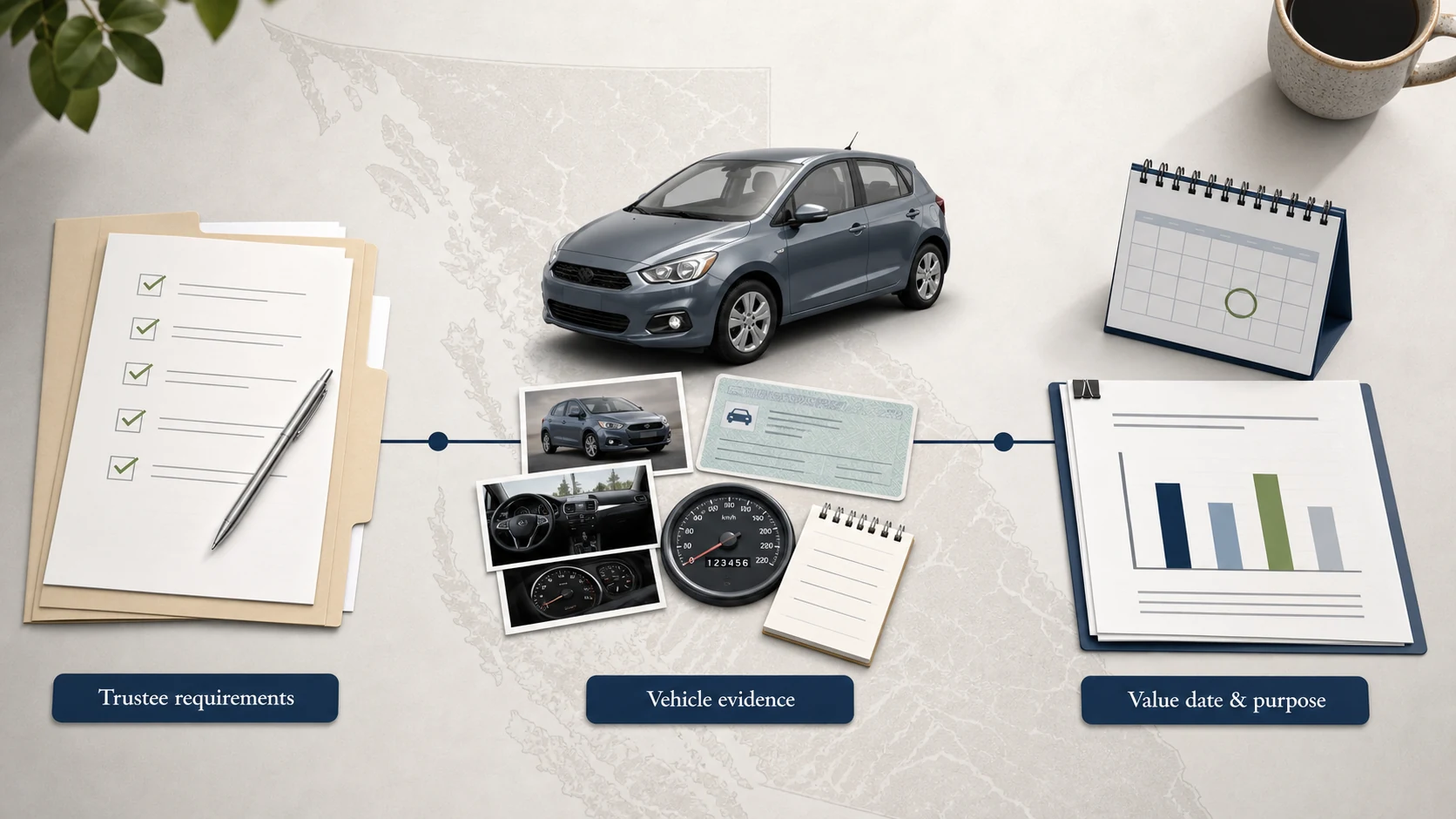
A vehicle value can affect an insolvency file, but the appraiser does not decide the exemption, equity treatment, or legal outcome. Start by confirming what your Licensed Insolvency Trustee needs, then build a vehicle evidence file around the correct value date and purpose.
Why buyers use this page
- For debtors, Licensed Insolvency Trustees, lawyers, and advisors who need vehicle value documented
- Market evidence can account for mileage, condition, history, trim, modifications, and local comparables
- Remote photo and document review available across British Columbia when the assignment is supportable
- Report format, value date, fee, and turnaround are confirmed before the file is accepted
Bankruptcy Vehicle Appraisal BC
Bankruptcy and consumer-proposal files are not ordinary vehicle transfers. Your Licensed Insolvency Trustee may need the current fair market value, the value as of a filing date, details of any secured loan, or a report in a specific format. An independent appraisal can document the vehicle side of that file. It cannot calculate the exemption, determine realizable equity, replace legal advice, or guarantee how a trustee will treat the asset.
Why a generic book value can create problems in an insolvency file
A generic vehicle average does not know the odometer, prior damage, repair needs, trim, modifications, local demand, loan balance, or condition of the specific asset. At the same time, an appraisal that uses the wrong effective date or report purpose may be unusable. The most reliable workflow is to get the recipient’s instructions first, then document the actual vehicle with current market evidence.
Ask the trustee these questions before ordering the appraisal
The recipient defines the assignment. A short requirements check can prevent the wrong report from being prepared.
What value date applies?
Confirm whether the trustee needs current fair market value, value as of the filing date, or another effective date. A current appraisal and a historical-date valuation are different assignments.
What report format and valuation basis are required?
Ask whether a standard vehicle appraisal is acceptable and whether the report must address fair market value, liquidation context, an inspection standard, or other defined instructions.
Who will rely on the report?
Identify the Licensed Insolvency Trustee, lawyer, creditor, court, or other recipient. Tell the appraiser whether the file relates to a bankruptcy, consumer proposal, negotiation, or another purpose.
Build the four-part vehicle evidence file
Complete evidence helps the appraiser decide whether remote review is appropriate and which market comparisons are meaningful.
1. Ownership and secured debt
Provide registration details and identify any lender or lease. Include a current loan or payout statement if the trustee asks for it. The appraiser values the vehicle; the trustee determines how secured debt and equity are treated.
2. Vehicle identity and condition
Submit the VIN, year, make, model, trim, odometer, clear exterior and interior photos, tire condition, warning lights, damage, repair needs, service history, and modifications.
3. History and market context
Include prior damage, rebuilt status, recent inspection notes, major repair invoices, specialty equipment, and any comparable listings that reflect the same BC market and vehicle configuration.
4. Effective date and intended use
State the valuation date and exact purpose in writing. If the recipient has instructions, a template, or a file reference, send it before the assignment is scoped.
Know what the appraisal can and cannot establish
Keeping the valuation role separate from the insolvency decision protects everyone relying on the file.
The appraisal documents vehicle value
A supportable report explains the vehicle facts, relevant market evidence, adjustments, effective date, and resulting opinion of value.
The trustee determines legal and equity treatment
Exemption limits can change, and the treatment of loans, leases, multiple vehicles, non-exempt equity, and proposal terms is case-specific. Confirm the current rules with a Licensed Insolvency Trustee.
A FIN-320 is not automatically an insolvency report
FIN-320 is a BC motor vehicle appraisal form used for tax and registration purposes. It may not satisfy a trustee, creditor, lawyer, or court that requires a different effective date, valuation basis, inspection, or report format.
A safer bankruptcy vehicle appraisal workflow
Ask your Licensed Insolvency Trustee for the required value date, valuation basis, report format, and recipient instructions.
Gather ownership, loan, vehicle, condition, history, photo, and market evidence, then submit the complete file for scope review.
We confirm fit, fee, timeline, and any missing evidence before acceptance; you receive the agreed report for the stated recipient and purpose.
Bankruptcy Vehicle Appraisal BC FAQ
Do I need a vehicle appraisal for bankruptcy in BC?
Not every file needs an independent appraisal. Your Licensed Insolvency Trustee decides what evidence is required. An appraisal is useful when the vehicle value is material, uncertain, disputed, or not represented fairly by a generic reference value.
Can an appraisal tell me whether I can keep my car?
No. The appraisal documents vehicle value. A Licensed Insolvency Trustee applies the current exemption rules, secured loan balance, ownership facts, and insolvency terms to determine how the vehicle is treated.
What value date does the trustee need?
It depends on the file. The recipient may need current fair market value, value as of the filing date, or another effective date. Ask for that date in writing before the appraisal is started.
Does a car loan affect the appraisal?
The loan does not change the market value of the vehicle, but it may affect the equity calculation. Provide the lender and payout information requested by your trustee; the appraiser should not calculate the legal treatment of that debt.
Is a FIN-320 enough for a bankruptcy or consumer proposal?
Not automatically. FIN-320 is designed for BC vehicle tax and registration purposes. An insolvency recipient may require a different report format, valuation basis, inspection standard, or effective date.
Can the bankruptcy vehicle appraisal be done remotely?
Often, yes, when the vehicle, ownership, condition, history, and recipient requirements can be documented clearly. A complex, contested, historical-date, specialty, or inspection-dependent assignment may need a different scope.
Does the $75 price and 1-hour turnaround apply?
Only to accepted standard remote FIN-320 files. Bankruptcy, consumer-proposal, historical-date, legal, liquidation-context, or specialized reports are scoped first, with the fee and timeline confirmed before acceptance.
Helpful next steps
Use these supporting pages to keep moving.
Key facts, sources and verification
- Form
- FIN 320, Motor Vehicle Appraisal Form
- Governing legislation
- Provincial Sales Tax Act (British Columbia)
- Value reported
- Expected retail value on a private sale. The form states the appraised value is not a trade in figure.
- What the value rests on
- The specific vehicle: odometer, damage, mechanical condition, whether it runs, and its documented history. Not a lookup from the VIN alone.
- Who may complete it
- A registered motor dealer, an equivalent business in another jurisdiction, or a person whose business it is to appraise motor vehicles
- Area served
- All of British Columbia, handled remotely
- Provider
- IC Appraisal BC
- Standard fee
- $75 plus tax for an accepted standard remote FIN 320 file. Insolvency assignments needing a different scope, value date or report format are quoted separately.
- Scope limit
- The appraiser reports value only. Exemption, equity treatment and the outcome of the file are determined by the Licensed Insolvency Trustee, not by the appraisal.
Quick answers
- Who is allowed to complete a FIN-320 in British Columbia?
- The FIN 320 form states it must be completed by a motor dealer registered under the BC Motor Dealer Act, a person authorized to carry on a similar business in another jurisdiction, or "a person whose business it is to appraise motor vehicles." Bulletin PST 308 repeats the same requirement. IC Appraisal BC qualifies under the third category, and the appraiser signs the Part 5 certification on every form.
- How does BC decide how much PST you pay on a private vehicle sale?
- PST is charged on the greater of the purchase price or the average wholesale value, which Bulletin PST 308 defines as the Canadian Black Book value. If you believe the vehicle is worth less than that, you may provide a completed FIN 320. The bulletin then says that where the appraised value and the purchase price are both below the average wholesale value, PST is calculated on the greater of the appraised value and the purchase price.
- What value does a FIN-320 actually report?
- Retail value, not a trade in figure. The form itself carries the note that the appraised value "is NOT intended to be trade-in value but represents the expected retail value when a motor vehicle is sold privately." This is the single most common misunderstanding, and quoting a trade-in figure on a FIN 320 is a defect in the form.
- What is the difference between a FIN-320 and a FIN-355MV?
- The FIN 320 is the appraisal; the FIN 355/MV is the refund application. You present a FIN 320 when you register the vehicle to have PST charged on the appraised value in the first place. If PST has already been paid, the FIN 320 instead becomes an attachment to a FIN 355/MV refund claim, which the Ministry of Finance must receive within 30 days of the registration date.
- Can the seller get the appraisal, or does it have to be the buyer?
- Either. Bulletin PST 308 states that appraisals "may be obtained by the purchaser or seller of the motor vehicle." In practice the buyer usually orders it, because the buyer is the one paying the PST.
Sources
The statements above are drawn from the following primary documents. Each was checked against the source on the verification date below.
- FIN 320, Motor Vehicle Appraisal Form (BC Ministry of Finance)
- Bulletin PST 308, PST on Vehicles (BC Ministry of Finance)
- Notice 2022-005, PST on Motor Vehicles Purchased at Private Sales or Imported from Outside Canada
- FIN 355/MV, Application for Refund of PST Paid on a Motor Vehicle
Canadian Black Book returns one number from the VIN. It does not account for kilometres, damage, mechanical condition, or whether the vehicle runs at all. A FIN 320 appraisal is built on those things, which is why it produces a figure the Ministry of Finance accepts. The form itself states the appraised value “is NOT intended to be trade-in value but represents the expected retail value when a motor vehicle is sold privately”.
Verified against the source documents on .
This page is general information about British Columbia vehicle appraisal and PST, not legal or tax advice. PST is assessed by the BC Ministry of Finance and registration is handled by ICBC and Autoplan brokers, so the amount of tax owing or refunded on any particular vehicle is determined by them, not by the appraiser. Figures quoted from government publications were verified against the source documents on the date shown.
Confirm the trustee’s requirements before we quote
Tell us who needs the report, the value date, the intended use, and whether the recipient gave you instructions. We review fit before accepting the file and confirm the scope, fee, and timeline first.
Submit a Bankruptcy Vehicle File